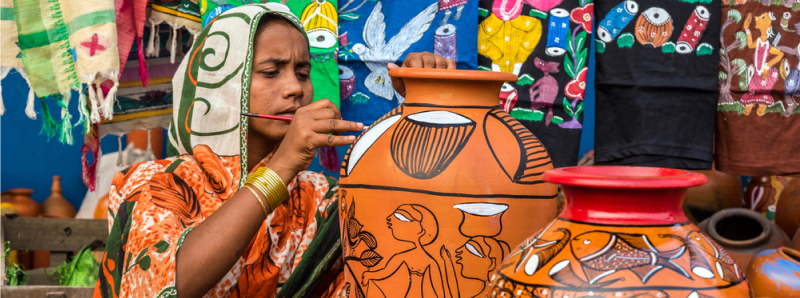
Pottery Skill
Pottery Training:
Pottery is an ancient profession that has developed alongside human civilization. It is one of the oldest and most traditional hereditary occupations, particularly associated with the Prajapati/Kumbhar (potter) community. Pottery offers a creative skill and a profitable self-employment opportunity. When compared to other cottage industries in the state, pottery is currently more prominent. Within home-based industries, it stands as one of the oldest and most traditional trades. By learning innovative designs through techniques beyond traditional pottery—such as Red Pottery, Black Pottery, Glaze Work, and Casting Work—an artisan can secure excellent employment in this profession.
No formal education is required for the pottery business. Even someone who is uneducated can easily learn and master this skill. However, being a hereditary occupation, it is primarily the Prajapati/Kumbhar community that is associated with this trade. There is a vast range of pottery products used in daily household life. Nowadays, due to health awareness, people insist on drinking water from clay pots (matlas), which has created strong market demand. Besides this, clay items are also used extensively for home decor and other decorative purposes. Furthermore, people in cities have now started using clay utensils for cooking. This makes it an excellent business opportunity, especially for women.
Self-Employment and Potential for Business in Rural Areas
Pottery is an excellent livelihood activity, especially in rural areas. The manufacturing of pottery items requires low investment, simple tools, and the raw material is easily available at the local level. This business can be started from home, even on a part-time basis, allowing individuals to earn while managing family responsibilities. With proper training, artisans involved in this trade can create marketable pottery articles.
Understanding Raw Materials for Pottery Making
The Prajapati-Kumbhar community, which is primarily associated with the art of pottery, is involved in this business hereditarily. As they have adopted this trade through inheritance, they are often unaware of modern production methods. Consequently, to survive in a competitive era, it is crucial for them to bring diversification and value-addition to their products. Therefore, during the pottery training, information about different types of clay and other relevant details are provided.
Various Articles Taught in the Training
In the organization's training program, practical training is provided to make various types of pottery articles as listed below:
- Clay Diyas (Lamps)
- Clay Pots
- Clay Kulhads (Cups)
- Clay Planters
- Various Clay Idols
- Decorative Articles
- Various types of Molds
Safety and Quality Control
During the training, methods are taught to work safely on the potter's wheel, ensuring that fingers or other objects do not get caught. Additionally, trainees are taught what should be mixed into the clay to ensure the final product is durable and long-lasting.
Business and Marketing Tactics
In the training, participants are given guidance on pricing, packaging, and branding. They are also taught how to sell their products through local markets, fairs, and online platforms. Furthermore, guidance is provided on how to avail benefits under various state government schemes after the completion of the training. After the training, even uneducated and rural entrepreneurs can start their own pottery business with low capital and earn a steady income.

